21 Jan 2016
Text things
# Giant heading
## Smaller heading
### Even smaller heading
etc.
Giant heading
Smaller heading
Even smaller heading
**bold text**
_text in italics_
bold text
text in italics
Links things
..to a page
Click here for the more complete [cheet sheet](https://github.com/adam-p/markdown-here/wiki/Markdown-Cheatsheet) we stole these points from.
Click here for the more complete cheet sheet we stole these points from.
..to an image


Pretty horizontal lines
---
21 Jan 2016
Text things
# Giant heading
## Smaller heading
### And even smaler heading
etc.
Giant heading
Smaller heading
And even smaler heading
**bold**
_italics_
bold
italics
1. ordered list
1. ordered list
  2. another item
- ordered list
- ordered list
- another item
* unordered list
* unordered list
  * another item
- unordered list
- unordered list
Code things
```
This is a block of code.
```
Links things
..to a page
Click here for the more complete [cheet sheet](https://github.com/adam-p/markdown-here/wiki/Markdown-Cheatsheet) we stole these points from.
Click here for the more complete cheet sheet we stole these points from.
..to an image

Tables
| Tables        | Are           | Cool  |
| ------------- |:-------------:| -----:|
| col 3 is      | right-aligned | $1600 |
| col 2 is      | centered      |   $12 |
| zebra stripes | are neat      |    $1 |
| Tables |
Are |
Cool |
| col 3 is |
right-aligned |
$1600 |
| col 2 is |
centered |
$12 |
| zebra stripes |
are neat |
$1 |
Pretty horizontal lines
---
21 Jan 2016
The effect of morphology upon electrophysiological responses of retinal ganglion cells (RGCs): simulation results
Links
Objective
To explore the relationship between differences in morphology of RGCs and certain electrophysiological phenomena that have been described.
Main outcome
Model prediction: difference between ON and OFF ganglion cells due to the presence of low voltage activated calcium currents in OFF cells and a lack of them in ON cells.
Model scope: The model seems to most accurately predict experimental outcomes for cells that have a large soma to total surface area.
(notes)
- Light enters the eye
- Hits the photo-receptors
- They connect to ON and OFF bipolar cells
- …retinal magic
- ON and OFF pathways converge in the visual cortex as simple cells
ON increases firing frequency with increasing light intensity
OFF S-cell: sustained, spontaneous spiking in darkness, a sustained component of spiking activity during illumination
OFF T-cell: transient, quiet in darkness, transient spikes at light offset
…what is alpha-like behaviour?
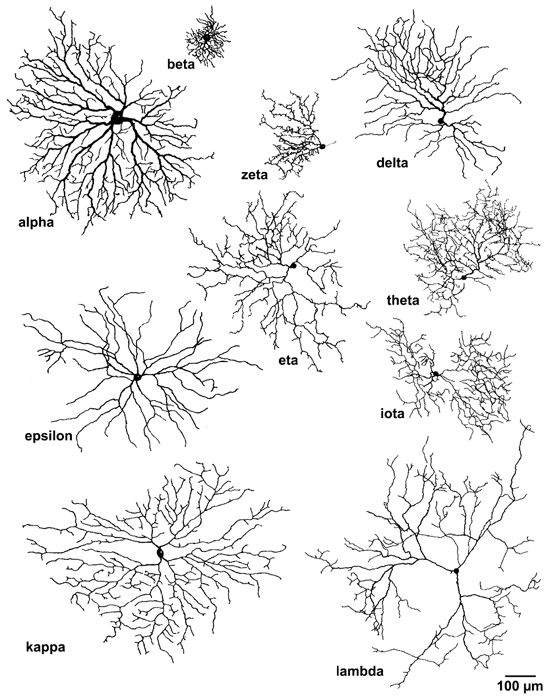
RGCs differ in stratification layer and size… this is an image from cat RGCs:
src
…the model
Multicompartment cell model
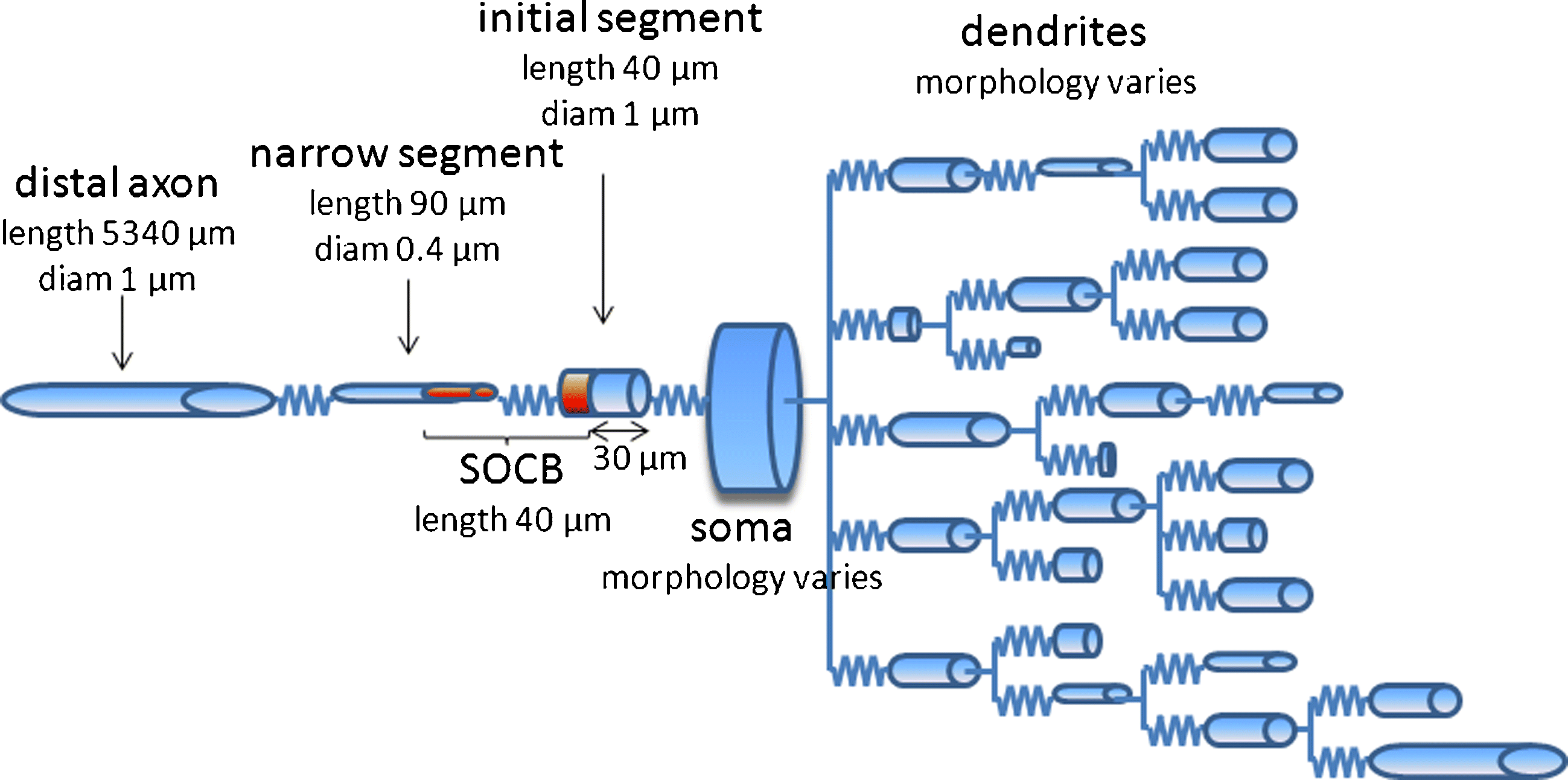
SOBC: sodium band channel: more sodium channels (d’uh)
Membrane dynamics: Hodgekin-Huxley type model (eq 1):
Included parameters:
* Leak, sodium, calcium, delayed rectifier potassium, A-type, Ca-activated potassium current - everything neatly modelled like others before this paper.
* Calcium reversal potential varied with time
* Calcium concentration depends on the calcium current (d’uh)
Ion channel distribution:
Different ion channel concentrations are given in Table 4.
This might be important - but maybe not:
- Leak conductance needed adjustment compared to a reference, because this study included additional inward currents that weren’t modelled in the other paper. If not for this adjustment, the outcome wouldn’t have matched the experimental values.
The model was tuned:
- certain ion channel conductances (NaP, T, h) were evaluated using data of another publication
The model was validated
…by comparing it to data.
The interesting bit (results)
- For certain cells, this model reproduced experimental data, for others it didn’t (see Table 5). The authors investigated the morphologies of the cells that did and didn’t work with the model.
- The authors also explored the effect of soma and dendrite surface area on the intrinsic electrophysiological properties of the cells.
Regarding 1:
- 88 of 200 cells did not meet the constraints. (some did not produce action potential, others spiked during hyperpolarizing stimulus…)
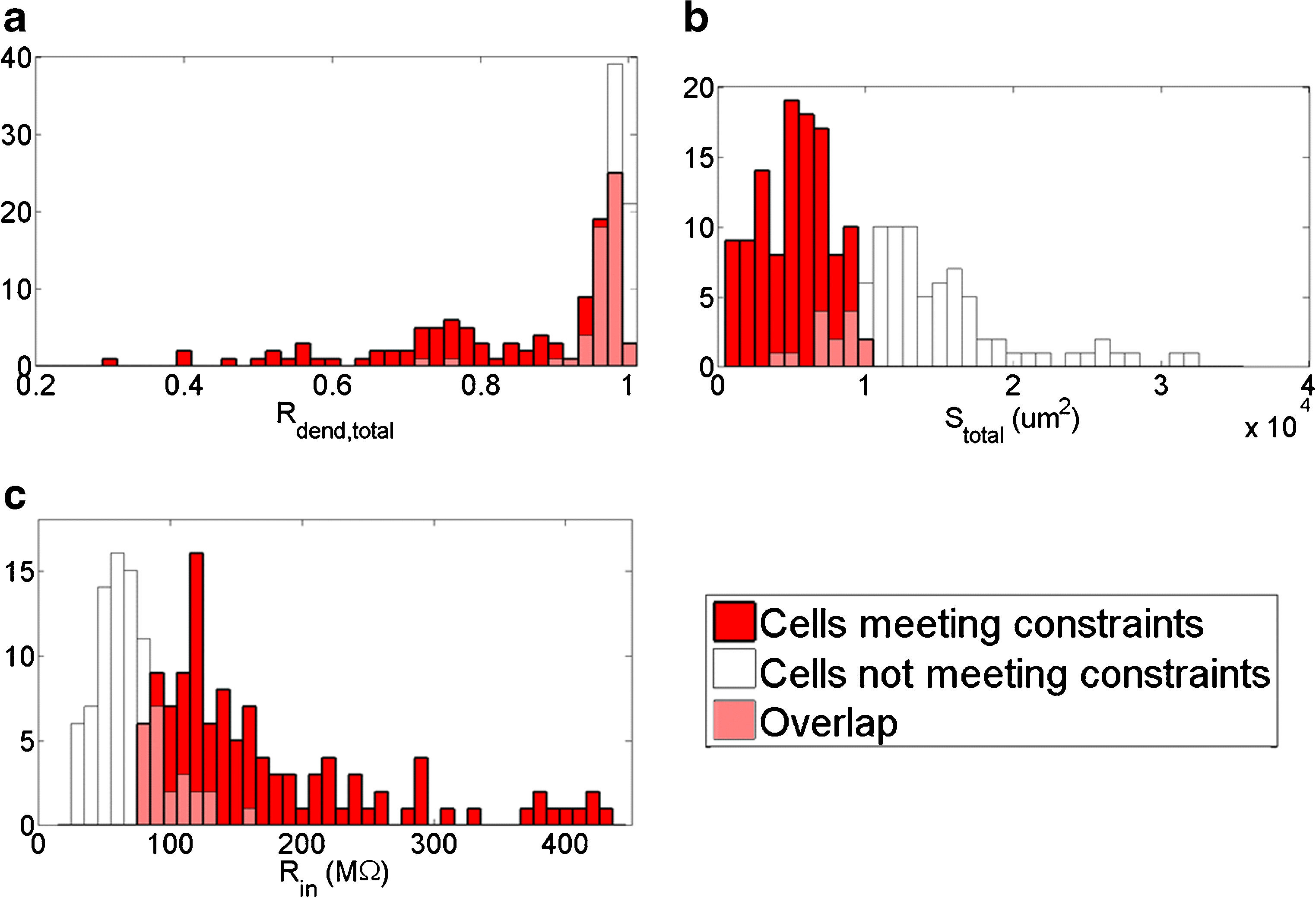 Cells not meeting the constraints had a high ratio of dendritic to total surface area, a larger soma, and a lower input resistance.
Regarding 2:
- Dendritic and somatic compartment size were (independently) reduced step by step - resting potential, spontaneous and rebound burst frequencies were calculated, rest was simulated.
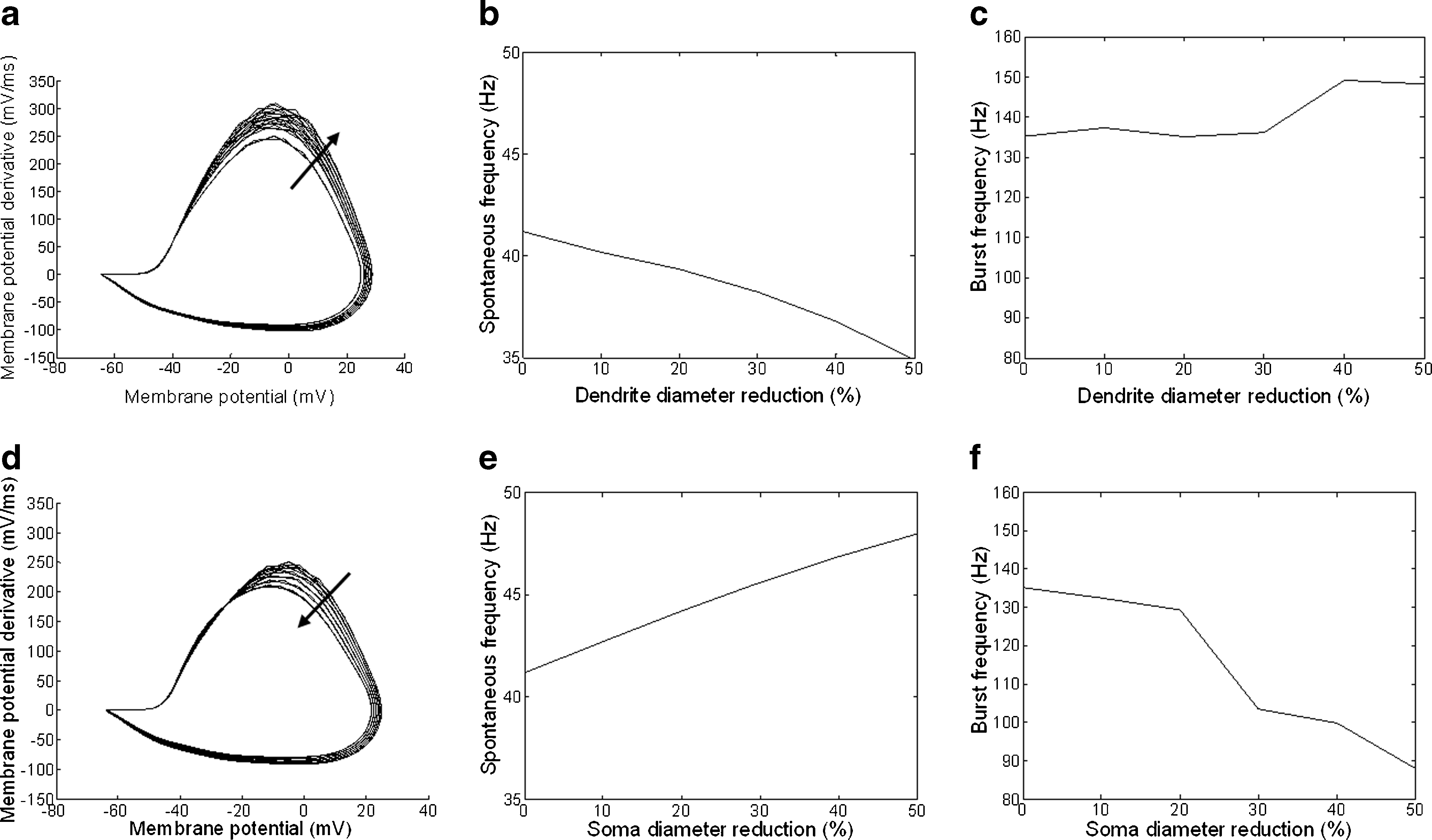 Off S (sustained) cell
Arrows point in the direction of decreasing size.
a dendritic surface reduction: The action potentials increased in maximal amplitude, and changed faster(?) - does that mean higher firing rate?
d somatic surface reduction: The action potentials decreased in maximal amplitude and changed more slowly.